SERVICES
Environmental and Contaminated Site Assessment
EC Otago are a one-stop-shop to assess and manage potentially contaminated land, and we work with you to achieve the best possible outcome.
Land that has previously been used for residential, industrial or agricultural activities can be affected by soil contamination, as noted in the Ministry for the Environment’s Hazardous Activities and Industries List (HAIL).
Under the Resource Management (National Environmental Standard for Assessing and Managing Contaminants in Soil to Protect Human Health) Regulations 2011 (NES), any HAIL property may require an investigation when subdivision, land-use change, soil disturbance, soil sampling or removal of fuel storage systems is proposed.
EC Otago can investigate the potential for contamination at a site via a Preliminary Site Investigation (PSI), which reviews the history of the site and past sources of contamination. We typically incorporate soil sampling and analysis to provide a factual basis for confirming whether contamination has occurred.
If required by site conditions, a Detailed Site Investigation (DSI) can be undertaken, with a more extensive soil sampling and analysis program.
We can prepare resource consent applications and Assessment of Environment Effects (AEE) to address the requirements of the NES.
If contamination is confirmed, EC Otago can assist with the planning for future developments, including a Site Remedial Action Plan (RAP) where required. We can work with your contractor to provide a Contaminated Soil Management Plan (CSMP) and conduct Health and Safety inductions to ensure the safety of everyone working on the project. We provide guidance for the appropriate disposal of contaminated soils and can facilitate disposal if necessary.
We can prepare a Site Validation Report (SVR) or soil disposal reports to confirm to Council that consent conditions have been met and that your site is safe for the proposed future use.
What is required for a contaminated site investigation?
The requirements for a contaminated site reporting are quite prescriptive. The Regulation 3 of the NES defines:
A Preliminary Site Investigation as an investigation that—
-
is done by a suitably qualified and experienced practitioner; and
-
is reported on in accordance with the current edition of Contaminated Land Management Guidelines No. 1 – Reporting on Contaminated Sites in New Zealand, Wellington, Ministry for the Environment; and
-
results in a report that is certified by the practitioner.
A Detailed Site Investigation as an investigation that—
-
is done by a suitably qualified and experienced practitioner; and
-
is done in accordance with the current edition of Contaminated Land Management Guidelines No. 5 – Site Investigation and Analysis of Soils, Wellington, Ministry for the Environment; and
-
is reported on in accordance with the current edition of Contaminated Land Management Guidelines No. 1 – Reporting on Contaminated Sites in New Zealand, Wellington, Ministry for the Environment; and
-
results in a report that is certified by the practitioner.
Filled Sites
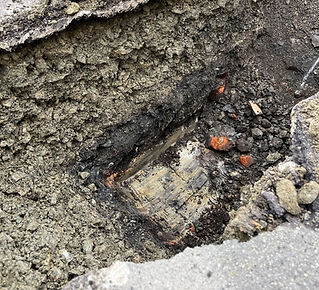
What lies beneath the surface of many sites in our cities is a constant surprise. Much of our land was once swamps, estuaries, tide flats or gullies. These areas of land were reclaimed through filling, often with industrial and household wastes. On the steeper hill slopes, level platforms were created by filling. Many of these sites have been subject to several phases of development with each development located on top of the demolished remains of the previous occupation. In some cases there are indications such as demolition debris, however high levels of heavy metals can be present with no visible signs.

Lead Paint
The traditional New Zealand villa, built with weatherboard, primed and painted with lead-containing products was the cornerstone of residential development. Weathering and regular maintenance such as waterblasting or sanding can result in contamination of soils around the house with high levels of lead, and house fires cause higher and more wide-spread contamination. This source of contamination is now widely recognised, and testing of soil is recommended to confirm the contamination status prior to redevelopment. This particularly applies to properties which contained houses built prior to 1945, due to the longer time of exposure and higher concentrations of lead in older products.

Farmland
Farms, especially old farms, can contain various hotspots of contamination, such as arsenic from historic sheep dips, lead from old weatherboard farm buildings, hydrocarbons from fuel tanks, and a range of contaminants in areas used for farm dumps or burn piles. If treated appropriately all of these can be effectively managed, remediated or isolated once identified and located without significantly impacting on the value of the development.

Orchards and Market Gardens
Most towns in the South were once surrounded by market gardens and orchards. These activities historically used toxic persistent chemicals such as lead arsenate, DDT and other persistent pesticides. They also sometimes used heavily contaminated materials such as wool waste or leather shavings as soil amendments.

Old Industrial Sites
Our towns and cities in the South Island have a long history of industrial activity. The industries tended to be messy and used materials from asbestos through to coal tar with a lack of awareness of their toxicity to the environment and potential for harm to human health. Old industrial sites are often capped rather than fully remediated and contain the sometimes-ugly remains of the past century and a half of industrial activities buried within.

Old Urban Sites
Our town centres were often originally residential areas that contained small cottages that were filled with lead including plumbing, roof flashings, lead head nails, lead paint and paint with arsenic, cadmium and chromium based dyes. These early dwellings often went through a transitional industrial use prior to their demolition in the mid to late 1800s, both of which commonly resulted in significant contamination of the site. This early occupation layer is the most widespread source of contamination of urban land.